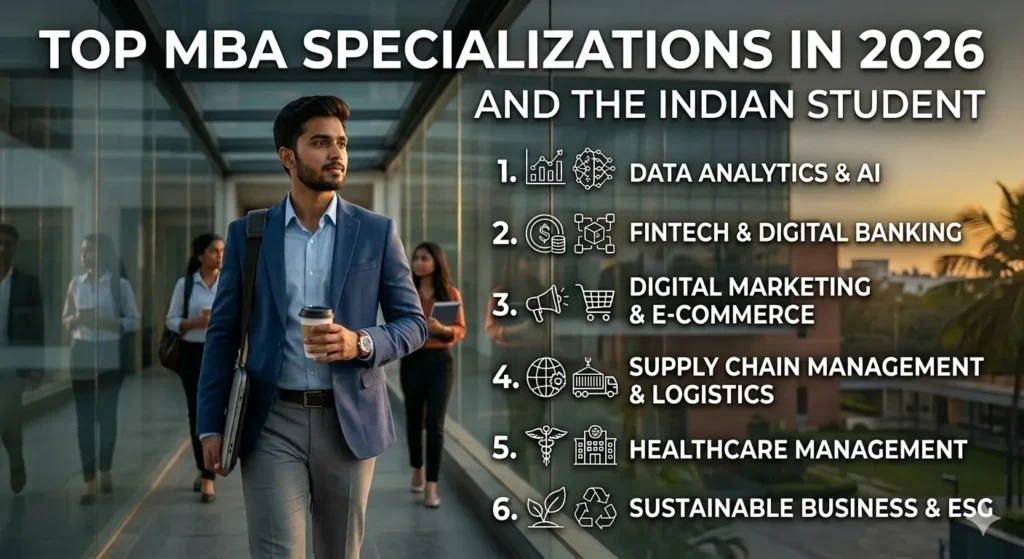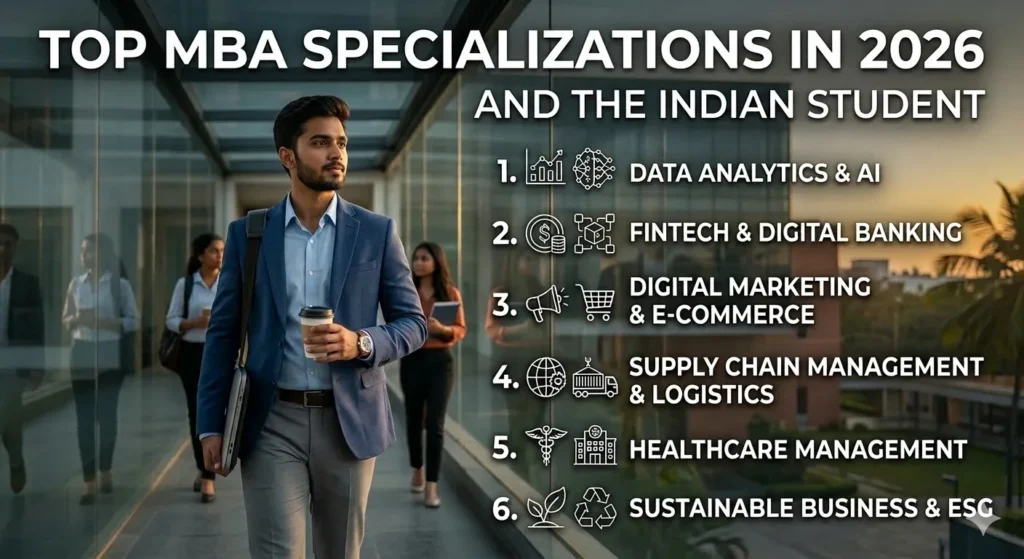
The business world is in constant motion, driven by rapid technological advancements, evolving global markets, and a growing emphasis on responsible practices. For aspiring MBA students and seasoned professionals alike, staying ahead means understanding how these shifts are reshaping management education.
Traditional MBA specializations like finance and marketing remain valuable, but a new wave of concentrations is emerging, equipping leaders with the specialized skills needed to thrive in the 21st century.
This guide explores 10 emerging MBA specializations that are worth considering in 2026, offering insights into their focus areas, career prospects, and the evolving landscape of business leadership.
The landscape of MBA programs has transformed significantly, moving beyond foundational business principles to embrace technology-enabled leadership. Automation, big data, artificial intelligence, and sustainability are no longer just buzzwords; they are integral components of modern business strategy.
As companies increasingly rely on data-driven decision-making and innovative digital solutions, MBA graduates with specialized expertise in these areas are in high demand.
This article will help you navigate these new opportunities, providing a clear picture of what to expect from these cutting-edge fields.
The Shifting Landscape: Traditional vs. Emerging MBA Specializations
For decades, MBA programs have offered core specializations that provided a solid foundation in business management. Finance, marketing, human resources, and operations have been the pillars, preparing graduates for established career paths. However, the rapid pace of technological change and the growing importance of global challenges like climate change have necessitated the evolution of MBA curricula.
Traditional specializations continue to offer stable career paths and a strong understanding of fundamental business principles. They are essential for many established industries and roles. Yet, the demand for specialized knowledge in areas directly impacted by digital transformation and new global priorities is surging. This has led to the rise of emerging specializations that address these contemporary needs, often blending core business acumen with technical skills and forward-thinking strategies.
Traditional MBA Specializations: Enduring Value
These established fields continue to be highly sought after, providing a robust understanding of core business functions.
| Specialization | Focus Areas | Typical Roles | India Salary Range (LPA) |
|---|---|---|---|
| Finance | Corporate finance, investment banking, risk management | Financial analyst, investment banker, CFO | ₹10-40 LPA |
| Marketing | Brand strategy, consumer behavior, digital channels | Marketing manager, digital strategist, brand lead | ₹8-20 LPA |
| Human Resource Management | Talent management, DEI, people analytics | HR director, talent acquisition lead | ₹7-15 LPA |
| Operations/Supply Chain Mgmt. | Logistics, procurement, operational efficiency | Supply chain manager, operations director | ₹8-18 LPA |
| International Business | Global strategy, cross-border management | Export manager, international business strategist | ₹9-22 LPA |
While these areas remain critical, the most dynamic growth and often the highest starting salaries are now found in newer fields.
Emerging MBA Specializations: The Future of Business Leadership
These concentrations are designed to meet the demands of a rapidly changing economy, focusing on technology, data, and sustainability.
| Specialization | Focus Areas | Typical Roles | India Salary Range (LPA) |
|---|---|---|---|
| Business Analytics / Big Data | Data modeling, predictive insights, Python, SQL, Tableau | Analytics manager, data consultant | ₹10-35 LPA |
| AI & Machine Learning | AI ethics, implementation, business applications | AI consultant, strategy lead | ₹12-35+ LPA |
| Sustainability / ESG | Impact investing, green strategy, climate finance | Sustainability officer, ESG analyst | ₹8-20 LPA |
| FinTech / Digital Business | Blockchain, digital payments, tech-enabled finance | FinTech product manager, digital banking specialist | ₹10-25 LPA |
| Healthcare Management | Health policy, hospital operations, pharma business | Healthcare administrator | ₹8-18 LPA |
These emerging fields are not just about acquiring new skills; they are about developing the strategic foresight to navigate complex, data-driven, and socially conscious business environments.
1. MBA in Business Analytics and Big Data
In today’s business environment, data is often called the new oil. Organizations are awash in information, but the ability to extract meaningful insights and translate them into actionable strategies is what truly sets successful companies apart. An MBA in Business Analytics equips professionals with the skills to manage, analyze, and interpret vast datasets. This specialization focuses on statistical modeling, data visualization, and the use of tools like Python, SQL, and Tableau to uncover trends, predict outcomes, and drive informed decision-making.
Graduates with an MBA in Business Analytics are highly sought after across industries, including technology, finance, e-commerce, and consulting. They are tasked with identifying business opportunities, optimizing processes, and understanding customer behavior through data. The demand for these roles is projected to grow significantly as more companies embrace a data-driven approach to strategy and operations. This specialization offers a strong foundation for roles such as Analytics Manager, Data Scientist, Business Intelligence Consultant, and Product Analyst. The salary potential is often among the highest, reflecting the critical value these professionals bring to organizations.
2. MBA in Artificial Intelligence (AI) and Machine Learning (ML)
Artificial Intelligence and Machine Learning are no longer confined to research labs; they are rapidly integrating into core business functions, from customer service and marketing to operations and product development. An MBA specializing in AI and ML prepares leaders to understand, implement, and ethically manage AI technologies within an organization. This program delves into AI ethics, the practical applications of machine learning algorithms, and strategies for integrating AI into business models to enhance efficiency, innovation, and competitive advantage.
Professionals with this specialization are crucial for companies looking to harness the power of AI. They can guide the development and deployment of AI solutions, ensuring they align with business objectives and regulatory frameworks. Typical roles include AI Consultant, AI Strategy Lead, and Machine Learning Product Manager. The rapid advancement and adoption of AI mean that demand for these skills is exceptionally high, particularly in tech, finance, and consulting sectors. This specialization offers a pathway to high-impact roles that are shaping the future of business.
3. MBA in Sustainability and Environmental, Social, and Governance (ESG)
As global awareness of climate change and social responsibility grows, businesses are increasingly expected to operate sustainably and ethically. An MBA in Sustainability and ESG focuses on integrating environmental, social, and governance principles into corporate strategy and operations. This specialization covers areas like impact investing, green finance, climate risk assessment, corporate social responsibility, and sustainable supply chain management. It prepares leaders to drive positive change while ensuring long-term business viability and stakeholder value.
Companies are actively seeking professionals who can navigate the complexities of ESG regulations, develop sustainability initiatives, and communicate their impact to investors and the public. Roles such as Sustainability Officer, ESG Analyst, and Climate Risk Manager are becoming standard in many organizations. This specialization is particularly relevant for industries facing significant environmental impact or those looking to attract socially conscious investors and consumers. The field is rapidly expanding, offering significant career growth potential as sustainability becomes a core business imperative.
4. MBA in FinTech and Digital Business
The financial services industry is undergoing a profound transformation driven by digital technologies. FinTech, or financial technology, encompasses a wide range of innovations, including blockchain, digital payments, cryptocurrencies, and AI-driven financial services. An MBA in FinTech and Digital Business equips students with the knowledge to understand these disruptive technologies and their impact on traditional financial models. The curriculum often includes topics like blockchain technology, digital payment systems, regulatory technology (RegTech), and the strategic management of digital financial platforms.
Graduates from this specialization are well-prepared for roles in the rapidly growing FinTech sector, as well as in traditional financial institutions undergoing digital transformation. They can work as FinTech Product Managers, Digital Banking Specialists, Blockchain Consultants, or Risk Analysts in financial technology firms. The demand for professionals who can bridge the gap between finance and technology is immense, making this a highly lucrative and dynamic specialization. It’s ideal for those interested in the intersection of finance, technology, and innovation.
5. MBA in Healthcare Management
The healthcare industry is a complex and ever-growing sector that requires specialized management expertise. An MBA in Healthcare Management prepares professionals to lead healthcare organizations, navigate regulatory environments, and improve patient care and operational efficiency. The curriculum typically covers health policy, hospital administration, healthcare finance, pharmaceutical business management, and the strategic use of technology in healthcare delivery. It addresses the unique challenges and opportunities within hospitals, clinics, insurance companies, and pharmaceutical firms.
Professionals with this specialization are essential for managing the intricate operations of healthcare systems. They are responsible for ensuring quality of care, managing costs, and adapting to evolving healthcare policies and technologies. Common career paths include Healthcare Administrator, Hospital Operations Manager, Health Policy Analyst, and Pharmaceutical Business Manager. As healthcare systems worldwide face increasing demands and complexities, the need for skilled managers in this field continues to rise, offering stable and impactful career opportunities.
6. MBA in Product Management
In today’s competitive market, the success of a business often hinges on its ability to develop and launch innovative products that meet customer needs. An MBA in Product Management focuses on the entire lifecycle of a product, from ideation and market research to development, launch, and ongoing management. This specialization equips students with skills in user research, market analysis, cross-functional team leadership, and strategic product roadmapping. It bridges the gap between technical development, marketing, and customer experience.
Product Managers are central to driving product strategy and execution in technology companies and beyond. They work closely with engineering, design, marketing, and sales teams to ensure products are successful in the market. Roles include Product Manager, Product Marketing Manager, and Growth Manager. This specialization is particularly valuable for those aspiring to lead product development in tech-driven industries, where innovation and customer-centricity are paramount. The ability to translate market needs into successful products is a highly valued skill.
7. MBA in Digital Marketing and Digital Transformation
The digital landscape has fundamentally altered how businesses connect with customers and operate internally. An MBA in Digital Marketing and Digital Transformation focuses on leveraging digital channels for marketing, sales, and overall business strategy. This specialization covers areas such as search engine optimization (SEO), social media marketing, content strategy, data analytics for marketing, and the broader implementation of digital technologies to transform business processes and customer engagement. It prepares leaders to navigate the complexities of the online world and drive digital innovation.
Professionals with this background are essential for companies looking to enhance their online presence, engage customers effectively, and adapt to the digital economy. They can lead digital marketing campaigns, develop e-commerce strategies, and guide organizational digital transformation initiatives. Typical roles include Digital Marketing Manager, Chief Digital Officer, and E-commerce Strategist. The continuous evolution of digital platforms and consumer behavior ensures that expertise in this area remains in high demand across nearly every industry.
8. MBA in Supply Chain Management and Logistics
The efficiency and resilience of supply chains have become critical concerns for businesses globally, especially in light of recent disruptions. An MBA in Supply Chain Management and Logistics focuses on optimizing the flow of goods and services from origin to consumption. This specialization covers areas such as inventory management, procurement, transportation, warehousing, and the strategic planning and execution of supply chain operations. It emphasizes building robust, agile, and cost-effective supply networks.
Graduates are equipped to manage the complex networks that keep businesses running, ensuring timely delivery, cost control, and operational excellence. They are vital in industries ranging from retail and manufacturing to e-commerce and healthcare. Common roles include Supply Chain Manager, Logistics Director, Procurement Specialist, and Operations Manager. As global trade continues to evolve and companies prioritize supply chain resilience, expertise in this area offers significant career stability and growth opportunities.
9. MBA in Entrepreneurship and Innovation
For individuals with a vision to start their own ventures or drive innovation within established organizations, an MBA in Entrepreneurship and Innovation is invaluable. This specialization focuses on developing the skills needed to identify opportunities, create business plans, secure funding, and manage the growth of new ventures. It also covers strategies for fostering innovation within existing companies, including design thinking, agile methodologies, and corporate venturing.
Graduates are prepared to launch startups, lead innovation labs, or drive new product development within larger corporations. They gain a deep understanding of market validation, business model generation, and scaling operations. Roles can range from Founder and CEO of a startup to Innovation Manager or Corporate Development Executive in established firms. This specialization is ideal for aspiring entrepreneurs and those who want to be at the forefront of business creation and transformation.
10. MBA in Data Science and AI for Business
While AI and Business Analytics are distinct specializations, an MBA that specifically integrates Data Science and AI for Business offers a more holistic approach. This program focuses on the practical application of data science principles and AI technologies to solve complex business problems and drive strategic advantage. It often includes advanced topics in machine learning, statistical modeling, data visualization, and the ethical considerations of AI deployment. The emphasis is on translating data insights into tangible business outcomes and leading data-driven initiatives.
This specialization prepares graduates for roles that require a deep understanding of both data science methodologies and business strategy. They are equipped to lead data science teams, develop AI-powered business solutions, and advise leadership on data strategy. Typical roles include Data Science Manager, AI Business Strategist, and Advanced Analytics Lead. The demand for professionals who can bridge the technical expertise of data science with strategic business acumen is exceptionally high, making this a powerful specialization for future career growth.
Choosing Your Path: Factors to Consider
Selecting the right MBA specialization is a critical decision that can shape your career trajectory. With the emergence of these new fields, it’s important to approach this choice strategically. Consider your personal interests, existing skills, and long-term career aspirations.
Aligning with Your Career Goals
Reflect on the types of problems you want to solve and the impact you want to make. Do you envision yourself leading a tech startup, driving sustainability initiatives, or optimizing global supply chains? Your chosen specialization should directly support these ambitions. Research the typical career paths and roles associated with each emerging field to ensure it aligns with your professional vision.
Assessing Market Demand and Salary Potential
While passion is important, market demand and earning potential are also key considerations. Emerging specializations in areas like AI, Business Analytics, and FinTech often command higher starting salaries due to their specialized nature and the critical skills they impart. Reviewing placement statistics from top business schools and industry reports can provide valuable insights into current hiring trends and salary expectations for graduates of these programs.
Evaluating Curriculum Depth and Faculty Expertise
Not all programs are created equal. It’s essential to look beyond the specialization title and examine the curriculum’s depth and rigor. Does the program offer hands-on projects, exposure to industry-standard tools, and opportunities for real-world application? Furthermore, the expertise of the faculty is crucial. Look for programs with professors who have significant industry experience or are actively involved in research within the specialization’s field.
Considering Program Format and Institutional Reputation
MBA programs are offered in various formats, including full-time, part-time, and online. Choose a format that best suits your personal and professional circumstances. Additionally, the reputation of the institution matters. Top-tier business schools often have stronger industry connections, better placement services, and more robust alumni networks, which can significantly benefit your career prospects. Researching specific programs and their outcomes is a vital step in making an informed decision.
Conclusion
The MBA landscape in 2026 is dynamic, with emerging specializations offering exciting new avenues for career growth and impact. Fields like Business Analytics, AI, Sustainability, FinTech, and Product Management are not just trends; they represent the future direction of business leadership. By carefully considering your career goals, market demand, curriculum depth, and institutional reputation, you can select a specialization that will equip you with the specialized skills and strategic foresight needed to thrive in an increasingly complex and innovative business world. Embracing these emerging fields is key to future-proofing your career and becoming a leader in the industries of tomorrow.